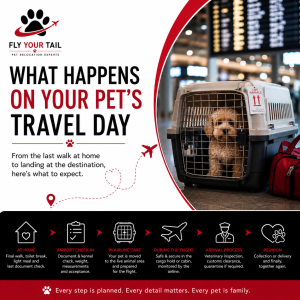
What Happens on Your Pet’s Travel Day?
Travel day is usually the part owners worry about the most.
By that point, all the preparation should already be done: documents checked, kennel ready, airline confirmed, permits in place, veterinary requirements completed and arrival arranged.
But what actually happens from the moment your pet leaves home until they are on the way to the destination?
It depends on whether your pet is travelling in cabin, as accompanied baggage or as manifested cargo, but the overall process usually looks something like this.
The day starts earlier than you think
Pet travel normally involves more time at the airport than a normal passenger journey.
For cabin or accompanied-baggage travel, the airline may ask you to arrive several hours before departure.
For manifested cargo, the pet may need to be delivered to the cargo terminal even earlier because the airline still has to complete:
- Document checks
- Kennel inspection
- Weight and dimension checks
- Cargo acceptance
- Security screening
- Air waybill processing
- Export clearance
- Transfer to the live-animal holding area
So if your flight leaves at 3pm, your pet’s airport day may start in the morning.
I always prefer to plan plenty of time rather than create unnecessary stress because everyone is rushing.
Before leaving home
The first thing is to keep the morning as normal as possible.
Your pet does not need to know that today is a big dramatic event.
I would normally recommend:
- A normal walk
- A toilet break before leaving
- Access to water
- A light meal if appropriate for the flight time
- No huge meal immediately before travel
- Familiar bedding where the airline allows it
- Any medication only as agreed with your veterinarian
For dogs, I like them to have enough exercise to take the edge off without exhausting them.
For cats, I would avoid chasing them around the house five minutes before you need to leave. Ideally, the carrier or travel kennel has already been part of their normal environment for some time.
The final document check
Before leaving for the airport, check the documents again.
And then check them one more time.
Depending on the route, you may need:
- Pet passport
- Vaccination records
- Microchip certificate
- Rabies titre report
- Import permit
- Export permit
- Health certificate
- Government endorsement
- Parasite-treatment record
- Quarantine confirmation
- Airline booking confirmation
- Air waybill
- Owner passport copies
- Customs documents
Some documents may need to travel with the pet. Others may stay with the owner or destination agent.
For complicated relocations, I like having both printed and digital copies.
You never want to discover at the cargo terminal that the original certificate is sitting on the kitchen table.
The kennel gets one final check
Before the pet goes inside, the travel kennel should be checked again.
I look at:
- Door closure
- Fasteners
- Ventilation
- Water bowls
- Absorbent bedding
- Labels
- Contact details
- Wheels removed or secured where required
- No loose items inside
- Correct kennel size
- Any airline-required reinforcement
The pet should be able to stand naturally, sit, turn around and lie down comfortably.
If the kennel is too small, the airline can refuse the pet.
Even if the kennel has already been reviewed before travel, the airline always makes the final acceptance decision at the airport.
If your pet is travelling in cabin
Cabin travel is usually the simplest airport process.
You check in with the airline and present the pet documents together with your own travel documents.
The airline may:
- Weigh the pet and carrier
- Measure the carrier
- Check the booking
- Review vaccination or import documents
- Confirm that the carrier fits the cabin requirements
The pet normally stays inside the carrier during check-in and boarding.
Security procedures vary by airport.
At some airports, the pet must come out of the carrier while the carrier goes through the X-ray machine.
If you have a cat or nervous dog, this is something I would prepare for.
Ask for a private security room if available rather than opening a carrier in the middle of a busy security area.
If your pet is travelling as accompanied baggage
The process is slightly different.
Your pet travels on your passenger booking, but usually in the aircraft hold rather than the cabin.
At check-in, the airline will review:
- Pet booking
- Veterinary documents
- Kennel
- Weight
- Flight and connection
- Breed restrictions
The pet may stay with you until closer to departure or be handed over at a special baggage area.
From there, the airline takes responsibility for moving the kennel to the aircraft.
This is often the moment owners find the hardest because it is when you physically say goodbye before the flight.
If your pet is travelling as manifested cargo
Cargo travel is much more operational.
Instead of going to the passenger terminal, you normally go to the airline’s cargo facility.
The pet is accepted under an air waybill, which is basically the transport document for the shipment.
At cargo acceptance, the airline or handler may check:
- Air waybill details
- Export documents
- Import documents
- Microchip
- Health certificate
- Kennel dimensions
- Kennel condition
- Total weight
- Breed
- Feeding and watering instructions
- Live-animal labels
- Contact information
They may also verify that the pet appears fit to travel.
If everything is correct, the pet is formally accepted into airline custody.
What happens after check-in?
This is the part owners do not normally see.
Once accepted, the pet may be moved to a secure live-animal holding area.
Depending on the airport, this area may be:
- Temperature controlled
- Away from normal cargo
- Staffed by trained handlers
- Close to the aircraft loading area
The pet remains in the kennel.
They may receive water if required.
For longer waits or transits, feeding and care depend on the airline and airport facilities.
This is why route planning matters so much.
Not every airport has the same live-animal infrastructure.
When does the pet go onto the aircraft?
Pets are usually loaded according to the airline’s operational procedures.
The exact timing varies, but live animals are generally handled differently from ordinary baggage or cargo.
The kennel is secured in the appropriate aircraft compartment.
The hold used for live animals must be suitable for the journey and operated under the airline’s approved procedures.
The crew is informed that live animals are travelling.
The exact aircraft is important because not every aircraft type can carry every pet or kennel.
This is one reason an aircraft change can affect a pet booking even when the passenger flight itself still operates.
What about temperature?
Temperature is one of the main things airlines monitor for pet transport.
Problems can happen during:
- Ground handling
- Loading
- Unloading
- Transit
- Long periods on the apron
This is especially important for:
- Brachycephalic breeds
- Senior pets
- Overweight pets
- Thick-coated breeds
- Animals with respiratory conditions
Sometimes an airline will refuse the pet on travel day because temperatures are outside its permitted range.
It is frustrating, but if that happens for welfare reasons, it is better than forcing the journey.
What happens during the flight?
For pets in the hold, there is no human sitting beside the kennel watching them during the flight.
They remain secured inside the kennel for the journey.
The aircraft compartment used for live animals is pressurised and temperature managed according to the aircraft and airline’s operating procedures.
Most pets spend much of the flight resting.
This is another reason crate training is so important.
If the kennel already feels like a familiar place, the pet is better prepared for the environment.
Can you give your pet sedatives?
Routine sedation for air travel is generally discouraged.
Sedatives can affect:
- Breathing
- Blood pressure
- Balance
- Temperature regulation
- The animal’s ability to respond normally
Airlines may also refuse a visibly sedated pet.
If your pet is very anxious, speak to your veterinarian well before travel day.
Do not decide at the airport that it would be a good idea to give them something new.
What happens during a transit?
Transit can be very different depending on the airport.
The pet may:
- Stay on the same aircraft
- Be transferred directly to another aircraft
- Move to a live-animal facility
- Have water replenished
- Receive feeding on longer transits
- Complete a veterinary inspection
- Wait several hours before the next flight
Some airports have excellent live-animal centres.
Others have much more limited facilities.
That is why I do not look only at flight duration when planning a route.
A slightly longer itinerary through a good animal-handling hub can be better than a shorter connection through an unsuitable airport.
Flight updates
Once the pet has been accepted, there is usually less to do from the owner’s side.
For cargo shipments, I normally monitor the flight and air waybill status.
That may include:
- Pet accepted by airline
- Flight departed
- Flight arrived at transit
- Connection confirmed
- Final flight departed
- Arrival at destination
This is not the same as GPS tracking the kennel.
What we can normally monitor is the airline and shipment status.
If anything changes, the destination arrangements may also need to change.
Delays and flight changes
Flights get delayed.
Aircraft change.
Connections are missed.
Weather changes.
This can happen with passenger travel and it can happen with pets too.
The important thing is having a plan for it.
If there is a disruption, questions immediately become:
- Where is the pet?
- Is the pet still with the airline?
- Is a live-animal facility available?
- Does the pet need feeding or water?
- Can the destination agent still receive the pet?
- Does the health certificate remain valid?
- Does the transit permit still work?
- Is the new aircraft suitable?
This is where having someone coordinating the full journey becomes very useful.
The pet lands — but the journey is not finished yet
Once the aircraft lands, the arrival process begins.
Depending on the destination, the pet may still need:
- Veterinary inspection
- Customs clearance
- Cargo release
- Quarantine transfer
- Airport collection
- Ground transport
If your pet travelled as manifested cargo, it may take several hours after landing before they are physically released.
If they travel into quarantine, you may not collect them at the airport at all.
So when you receive the message:
“Your pet has landed.”
That is very good news.
But it is not always the final step.
What should you do while your pet is flying?
Try not to refresh the flight tracker every 30 seconds.
I know that is easier said than done.
Make sure:
- Your phone is on
- You are reachable
- The destination agent has your details
- You know where collection will happen
- Your home is ready
- Water, food and bedding are prepared
- You have safe transport from the airport
And then wait.
At that point, all the important work should already have been done.
The hardest part is usually saying goodbye
I think for most owners, the worst moment is not the flight.
It is handing the kennel over.
Until then, you have been doing something constantly: vaccinations, documents, appointments, kennel training, bookings.
Then suddenly someone takes your pet through a door and there is nothing else you can do.
That is difficult.
But a properly prepared travel day should actually be quite boring.
Documents correct.
Kennel accepted.
Pet checked in.
Flight departs.
Pet arrives.
That is exactly what we want.
Good travel days are planned weeks or months before
What happens at the airport is only the final part of the process.
A smooth travel day usually comes from all the preparation that happened before it:
- Correct documents
- Correct vaccination sequence
- Correct kennel
- Suitable airline
- Realistic transit
- Proper arrival arrangements
- Good crate training
- Enough time
That is why I always prefer to deal with potential problems before the pet reaches the airport.
Travel day is not the day to discover that a kennel is too small or a health certificate is missing.
How Fly Your Tail supports travel day
When Fly Your Tail manages a relocation, travel-day support can include:
- Final document checks
- Airline confirmation
- Collection coordination
- Airport or cargo-terminal instructions
- Cargo acceptance support
- Flight and air waybill monitoring
- Transit coordination
- Destination-agent communication
- Arrival updates
- Quarantine or delivery coordination
Every case is different, so the exact support depends on the service booked and the route.
But the aim is always the same: everyone involved should know what is happening and what happens next.
Planning an international move with your pet?
Send me your pet’s details, route and preferred travel date and I can assess the available options and the preparation required.