
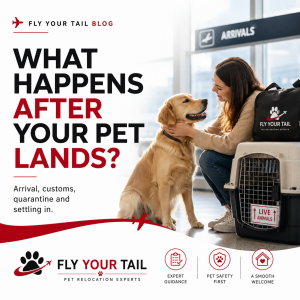
What Happens After Your Pet Lands?
For most owners, the flight itself is the part they worry about the most.
But one thing I always explain to clients is that landing does not necessarily mean your pet is ready to walk out of the airport five minutes later.
What happens next depends on the country, airport, airline, travel method and whether your pet has arrived in cabin, as accompanied baggage or as manifested cargo.
Sometimes the process is very quick. Other times there are several steps between touchdown and reunion.
Here is what usually happens after your pet lands.
First, the pet is unloaded from the aircraft
After landing, pets are normally unloaded according to the airline and airport’s live-animal procedures.
If your pet travelled as manifested cargo, they are usually transferred from the aircraft to the airline cargo terminal or designated live-animal handling area.
If they travelled as accompanied baggage, the process may be different depending on the airport. In some countries the pet is collected from a special baggage area, while in others they are transferred directly to the veterinary or quarantine inspection point.
Cabin pets may stay with the owner, but they still have to complete whatever veterinary and customs procedures apply at the destination.
So even though all three pets may have been on the same flight, the arrival process can be completely different.
Then comes the veterinary or quarantine inspection
Many countries require imported pets to be checked by an official veterinarian or animal quarantine officer before they are released.
They may check:
- Microchip number
- Health certificate
- Rabies vaccination
- Vaccination records
- Rabies titre test
- Import permit
- Parasite treatments
- Quarantine booking
- Other destination-specific documents
They may also look at the pet to make sure they appear healthy.
If everything matches and the documents are correct, this part is normally straightforward.
If something does not match, this is where delays can happen.
A wrong microchip digit, missing original document or treatment done outside the correct time window can suddenly become a much bigger problem once the pet is already at the destination.
This is why I am quite obsessive about checking documents before travel.
Customs clearance may also be required
Veterinary clearance and customs clearance are not always the same thing.
For cargo shipments especially, customs may need to review things such as:
- Air waybill
- Owner or importer details
- Customs declaration
- Value of the animal
- Import purpose
- Taxes or duties, where applicable
- Import permits
Sometimes this is a very simple process.
Sometimes a customs broker or destination agent has to handle it.
This is one of the reasons I always want to know exactly who is receiving the pet at destination before the flight departs.
If quarantine is required, the pet is transferred there
For destinations such as Australia, New Zealand or certain Singapore cases, arrival is only the beginning of the quarantine process.
The pet may be collected directly by quarantine staff or an authorised transporter and moved to the government or approved quarantine facility.
Owners are not always allowed to collect the pet themselves.
The quarantine team then completes their own checks before the animal is admitted.
Depending on the country and case, the stay may be a few days or much longer.
If your pet is going into quarantine, you should know before travel:
- Where the facility is
- How the transfer works
- How long the planned stay is
- Whether visiting is allowed
- What happens if the pet needs medication
- How release and collection work
Quarantine should never come as a surprise on arrival.
Cargo pets normally take longer to release
This is something owners are sometimes surprised by.
When a pet travels as manifested cargo, the aircraft can land but the pet may still need several hours before release.
There can be:
- Aircraft unloading
- Transfer to the cargo terminal
- Cargo-document processing
- Veterinary inspection
- Customs clearance
- Airline or terminal charges
- Cargo release
- Final collection or delivery
At a busy airport, this can take time.
So when I tell a client that their pet has landed, it does not necessarily mean I can tell them, “They will be in your house in 20 minutes.”
I prefer to explain exactly which stage we are at.
Your pet may look tired when you first see them
After a long journey, pets can look very different from the photos we normally take at home.
They may be:
- Very thirsty
- Sleepy
- Excited
- Quiet
- Confused
- Hungry
- Not interested in food at all
- Desperate to urinate
- Slightly messy from the journey
All of this can be completely normal.
Some pets come out of the kennel acting like nothing happened.
Others need a few hours to decompress.
I have seen dogs come out wanting cuddles immediately, and others that just want water, a toilet break and somewhere quiet to sleep.
Cats are often even more offended by the entire experience and may prefer to hide for a while.
That does not necessarily mean anything is wrong.
Do not overwhelm them immediately
I know the first instinct is to open the kennel, hug them, give them a giant meal and have the whole family waiting.
I would keep the first few hours much calmer.
Once your pet is safely released:
- Offer fresh water
- Give them a toilet break
- Let them stretch
- Keep them somewhere quiet
- Offer a small meal rather than a huge one
- Give them familiar bedding if possible
- Let them sleep
After a long flight, I would not immediately organise a huge welcome party.
They have just experienced aircraft noise, strange smells, movement, airport handling and probably a completely new environment.
Give them a little time.
Keep them secure
This is extremely important.
A pet that is normally very calm can behave differently after a long journey.
They are in a new country, surrounded by unfamiliar smells, sounds and people.
Dogs should be on a secure lead and ideally a well-fitted harness when they first come out.
Cats should stay inside a secure carrier until they are in a closed room.
The airport car park is definitely not the place to find out that your dog can suddenly reverse out of their collar.
For anxious pets, I like using two points of security during the first transfer whenever possible.
Check how they are physically
Once they are somewhere calm, have a proper look at them.
Check:
- Breathing
- Gums
- Eyes
- Walking
- Hydration
- Urination
- Stool
- Appetite
- Any vomiting
- Any obvious injuries
- The condition of the kennel
A little tiredness is expected.
What I would not ignore is something like:
- Difficulty breathing
- Collapse
- Very pale or blue gums
- Repeated vomiting
- Severe diarrhoea
- Bleeding
- Extreme weakness
- Inability to stand
- Severe distress
If something does not look right, contact a veterinarian.
They may not eat immediately
This worries owners quite often.
Some pets are hungry the moment they arrive.
Others will not eat for several hours.
Stress, travel, time-zone changes and unfamiliar surroundings can temporarily affect appetite.
Offer their normal food in a small amount.
I would avoid suddenly giving them lots of treats or completely new food just because you feel guilty about the journey. That is a very easy way to add an upset stomach to the situation.
Water is the priority.
Bathroom habits may be strange for a day or two
Your pet may not urinate or defecate on their normal schedule immediately after travel.
They may have held it for a long time or simply feel uncomfortable going in a new place.
Dogs may need several calm walks before they relax enough.
Cats should have immediate access to a clean litter tray in a quiet room.
Some temporary changes in stool can also happen after travel and stress.
Again, if something seems severe or continues, speak with a vet.
The first night
For most pets, I keep the first night simple.
They need:
- Water
- Their normal food
- A secure room
- Comfortable bedding
- Easy toilet access
- Quiet
Do not expect them to immediately understand the new house.
Even a very confident pet can be unsettled after relocation.
Your dog may follow you everywhere.
Your cat may disappear under the bed.
Both are pretty normal reactions.
Give them time to adjust to the new country
The journey ends when the pet arrives, but the relocation does not really end there.
They also need to adjust to:
- A new home
- New smells
- New sounds
- Different weather
- Different walking environment
- New animals
- New people
- Different routines
- Sometimes a completely different climate
Try to keep some familiar things the same.
Their normal food, bedding, toys and routine can make a big difference.
You do not need to introduce them to the entire new world on day one.
For dogs, be careful with the climate
If you have moved from a cold country to somewhere hot and humid, do not assume your dog will immediately cope with it.
This is especially important for:
- Brachycephalic breeds
- Senior dogs
- Overweight dogs
- Thick-coated breeds
- Dogs with respiratory or heart problems
Walk early in the morning or later in the evening and give them time to acclimatise.
The opposite applies when moving somewhere very cold.
Find a local veterinarian
I recommend finding a local vet fairly soon after arrival, even if your pet is completely healthy.
You do not necessarily need an appointment on day one, but it is useful to know:
- Where the nearest clinic is
- Which emergency clinic operates 24 hours
- What local parasite prevention is recommended
- Whether your pet needs local registration
- When their next vaccination is due
Keep copies of all the import documents.
Do not throw them away once the journey is finished.
You may need them again if you relocate in the future.
And finally, enjoy the reunion
This is the part that makes all the preparation worth it.
After months of permits, blood tests, paperwork, airline bookings, kennels and worrying, suddenly the pet is there.
Home.
I think this is why arrival is still my favourite part of every relocation.
The job is not really finished when the plane lands. For me, it is finished when the pet has cleared the airport, completed any quarantine or customs process, and is safely reunited with their family.
That is the moment everyone has been working towards.
Moving your pet internationally?
If you are planning an international relocation and want help with the documentation, route, airline arrangements, quarantine or arrival process, send me your pet’s details and travel plans.