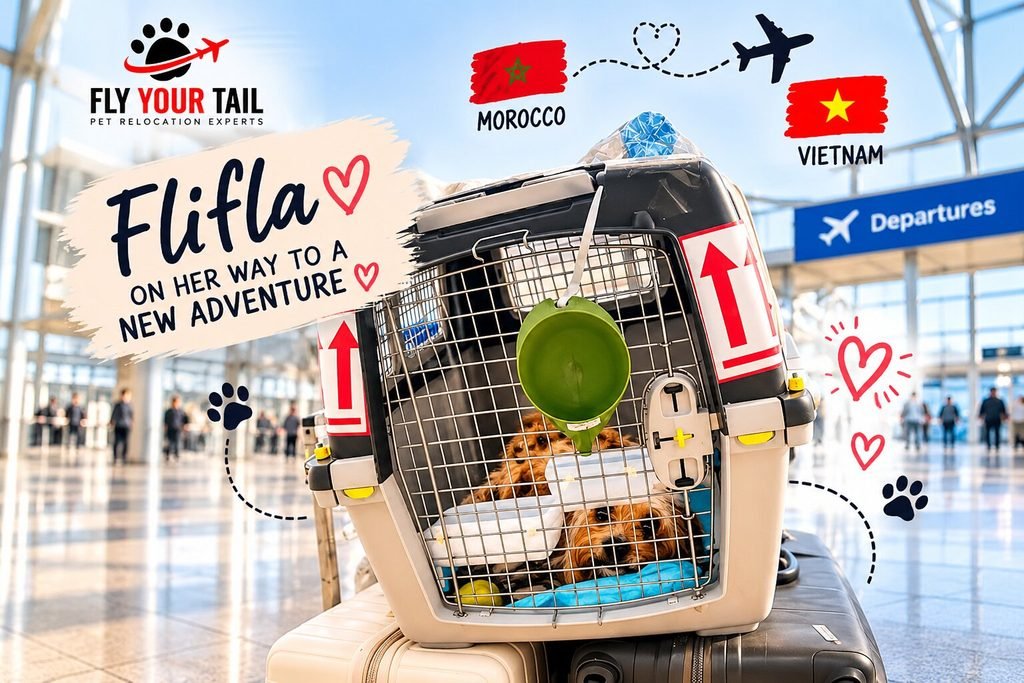
Moving a dog or cat from Morocco to Vietnam is possible, but it isn’t always as simple as following a checklist. This case study explains what happened during Flifla’s relocation, why the veterinary health certificate became the main challenge, and what it shows about planning an international pet move.
Moving a pet from Morocco to Vietnam sounds relatively straightforward. Check the Vietnam pet import requirements, prepare the vaccinations and veterinary documents, arrange the flight and send the pet to Vietnam. Right? Well… sometimes.
And then there are cases like Flifla. Flifla’s relocation from Morocco to Vietnam became one of those cases that perfectly explains what international pet relocation actually looks like behind the scenes.
The problem wasn’t Flifla. It wasn’t the airline. It wasn’t even the route. The problem was that the Moroccan veterinary authority needed confirmation from the Vietnamese veterinary authority about which veterinary health certificate should be used to export Flifla from Morocco to Vietnam. So suddenly I found myself trying to get two government authorities, thousands of kilometres apart, to talk to each other. Welcome to international pet relocation.
Moving a Pet from Morocco to Vietnam
For Flifla’s relocation, the owner was handling the Moroccan pet export procedures, while we at Fly Your Tail were responsible for coordinating the Vietnam side. Our job was to make sure Flifla would meet the requirements to enter Vietnam and that the documentation prepared in Morocco would be acceptable when the pet arrived.
We checked the Vietnamese requirements and worked with the relevant contacts here to understand what Vietnam needed. Everything was moving relatively normally. Until we reached the veterinary health certificate.
The Morocco to Vietnam Veterinary Health Certificate Problem
When a dog or cat travels internationally, a veterinary health certificate isn’t simply a letter from a veterinarian saying “The animal is healthy.” Depending on the countries involved, the certificate may need to include specific information about the pet’s identification, vaccinations, health status, origin and other veterinary requirements. It may also require official endorsement by the exporting country’s competent veterinary authority.
In Morocco, that authority is ONSSA — Office National de Sécurité Sanitaire des Produits Alimentaires. For Flifla’s export, ONSSA needed to know which veterinary certificate Vietnam expected Morocco to issue. And because Morocco → Vietnam isn’t exactly one of the world’s most common pet relocation routes, there wasn’t a simple established certificate sitting there ready for everyone to use. That was when things became interesting.
ONSSA Wanted Confirmation Directly From the Vietnamese Authority
On the Vietnamese side, we had already discussed what was required. Vietnam had indicated that an English veterinary certificate containing the necessary information, including the relevant information regarding the animal’s origin and rabies status, could be accepted. We also had a proposed certificate model.
But ONSSA wanted the certificate model to be confirmed directly by Vietnam’s competent veterinary authority. And honestly, I understand why. ONSSA is the government authority responsible for the Moroccan export documentation. They need to know that what they certify will actually be accepted by the destination country. They didn’t simply want an owner or pet relocation company saying “Vietnam told us this is okay.” They wanted confirmation from Vietnam itself. Fair enough. Except there was a problem.
Morocco Had Contacted Vietnam — But Vietnam Hadn’t Answered
We were told that ONSSA had already contacted the Vietnamese competent authority requesting confirmation of the veterinary certificate. But they hadn’t received a response. Okay. No problem. I’ll chase Vietnam. Except… who exactly did they contact?
We didn’t have visibility over the email address or Vietnamese department to which the request had originally been sent. And suddenly we had this situation:
🇲🇦 Morocco: We need Vietnam to confirm the veterinary certificate.
🇻🇳 Vietnam: We can confirm what is required.
🇲🇦 Morocco: We contacted Vietnam already.
🇻🇳 Vietnam: Where did you send it?
🇲🇦 Morocco: …
And somewhere in the middle of all this was Flifla, who just wanted to move to Vietnam.
The Part of International Pet Relocation You Don’t Normally See
When people search for information about moving a dog or cat to Vietnam, most questions are about things like:
- Rabies vaccination
- Microchips
- Veterinary certificates
- Import requirements
- Airlines
- Travel kennels
- Cargo
- Flight routes
Those things are obviously important. But sometimes the flight is actually the easiest part of the relocation. International pet transport requires several different parties to agree with each other. You can have the pet ready, an airline willing to transport the pet, and a suitable kennel, and you can still be unable to travel because one piece of government documentation hasn’t been resolved.
In Flifla’s case, we weren’t looking for another airline. We were trying to establish the correct documentary pathway between the Moroccan veterinary authority and the Vietnamese veterinary authority.
Why Didn’t We Just Use Another Health Certificate?
Because I don’t like the word “probably” when somebody’s pet is crossing an international border. Could we prepare a veterinary certificate that appeared to contain everything Vietnam required and hope it would be accepted? Maybe. Would I send a client’s pet based on “It will probably be fine”? Absolutely not.
If there is uncertainty about an international veterinary certificate, I want that uncertainty resolved before the animal gets on the aircraft. The worst time to discover that an import authority doesn’t accept a veterinary document is when the pet has already landed. A paperwork problem that seems small while the pet is safely at home can become a very serious problem once the animal is standing at an international border. So we kept working on getting confirmation.
Coordinating With the Vietnamese Animal Health Authorities
Because Fly Your Tail was responsible for the Vietnam side of Flifla’s relocation, we started chasing the issue from here. We contacted the relevant Vietnamese animal-health authorities to explain the situation and tried to determine whether ONSSA’s communication had actually reached the correct department. We also worked through the relevant animal-quarantine contacts in Vietnam to try to get the certificate request in front of the appropriate people.
The objective was simple: either locate the original communication from Morocco or have the Vietnamese authority confirm the veterinary certificate model directly to ONSSA. Basically, if Morocco couldn’t find Vietnam, we were going to help Morocco find Vietnam.
Meanwhile, Flifla’s Other Documents Still Had to Be Prepared
This is another thing people don’t always realise about international pet relocation. Just because one problem appears doesn’t mean everything else stops. While we were dealing with the veterinary certificate issue, Flifla’s other documentation still needed to be reviewed and prepared. Vaccination information needed to comply with Vietnam’s requirements, veterinary information needed checking, additional paperwork needed to be prepared, and everything still had to fit with the eventual travel plan.
International pet relocation is basically a chain:
Pet → Veterinarian → Export authority → Airline → Import authority → Customs/quarantine → Destination
Every link needs to work. If one link stops, the whole journey can stop.
Why Unusual Pet Relocation Routes Need More Time
This is probably one of the biggest lessons from Flifla’s case. If you’re planning to relocate a pet from Morocco to Vietnam, start early. Actually, this applies to almost every international pet relocation.
People sometimes contact me and say, “We’re moving in three months. Is that too early to contact you?” No. Please contact me. Three months is lovely. Because you simply don’t know what you’re going to discover until somebody starts checking the actual case.
For a common route, the process may already be very well established. The exporting authority knows the certificate, the airline knows the procedure, and the destination handles pets from that country regularly. Everything moves relatively smoothly.
But with less common routes, you can encounter questions nobody expected. Maybe the exporting authority doesn’t have the destination country’s certificate model. Maybe the importing authority needs to confirm some wording. Maybe a particular test is required. Maybe an airline doesn’t accept the breed. Maybe the obvious route doesn’t accept live animals. Or maybe one government authority simply needs another government authority to answer an email. And government authorities don’t necessarily work according to your flight date.
What Flifla’s Morocco to Vietnam Relocation Taught Us
Flifla’s case is a good example of why international pet relocation isn’t simply about booking a pet onto an aircraft.
1. Pet import requirements are only one part of the process
Knowing Vietnam’s pet import requirements is essential. But the Moroccan pet export requirements also need to work with them. Both sides have to align.
2. The veterinary health certificate matters
A health certificate isn’t something we want to improvise. The exporting authority needs to be comfortable issuing it, and the importing authority needs to be comfortable accepting it.
3. Less common routes can require government-to-government coordination
Not every pair of countries has a well-established pet movement pathway. Sometimes additional clarification between competent veterinary authorities is necessary.
4. Solve documentation problems before travel
This is probably the most important one for me. I’d much rather spend days chasing emails while the animal is safely at home than discover a problem after the pet has landed.
5. Start your pet relocation early
You can always be pleasantly surprised when everything is easy. It’s much harder to create extra time when something isn’t.
What Does a Pet Relocation Company Actually Do?
People sometimes ask why they need a pet relocation company when they could technically arrange many of these things themselves. And honestly? For some straightforward relocations, owners absolutely can. But complicated cases are where the difference becomes much clearer.
At Fly Your Tail, we’re not simply booking a flight for a dog or cat. We’re looking at the entire journey:
Origin country → Export requirements → Veterinary documents → Airline → Route → Transit → Import requirements → Customs/quarantine → Final destination
When something doesn’t work, we need to understand why. Sometimes we change the airline. Sometimes we change the route. Sometimes we correct the veterinary documents. Sometimes we need a different kennel. Sometimes we tell the owner we don’t believe the journey can be done safely. And apparently sometimes our job is: “Hello Vietnam, Morocco would like to speak to you.”
Can You Move a Dog or Cat From Morocco to Vietnam?
Yes, pets can be relocated between Morocco and Vietnam, but the exact requirements and process need to be checked for the individual animal and current regulations. Don’t assume that having a microchip, rabies vaccination and general health certificate automatically means your pet is ready to travel.
You need to consider both Moroccan pet export requirements and Vietnam pet import requirements. The veterinary documentation needs to satisfy the relevant authorities, and for less frequently travelled routes additional coordination may sometimes be necessary. Requirements can also change, so don’t rely solely on somebody else’s relocation experience from several years ago.
Planning a Pet Relocation From Morocco to Vietnam?
Start early. That’s probably the best advice I can give you after Flifla’s case.
At Fly Your Tail, we organise international pet relocations to and from Vietnam and worldwide, including the complicated routes that don’t necessarily have an obvious solution. We work with dogs, cats and other animals, and regularly handle cases involving unusual routes, large dogs, brachycephalic pets, restricted breeds and complex veterinary requirements.
There isn’t always a copy-and-paste solution. And honestly, that’s one of the reasons I enjoy this job. There’s something very satisfying about receiving a case that initially looks like “How on earth are we going to do this?” and eventually getting to “Okay. We have a plan.”
Contact Fly Your Tail to discuss your pet’s relocation
Anything you need, I am here
Frequently Asked Questions
Who is ONSSA, and what is its role in exporting a pet from Morocco?
ONSSA (Office National de Sécurité Sanitaire des Produits Alimentaires) is the Moroccan veterinary authority responsible for the export documentation. In Flifla’s case, ONSSA needed to know which veterinary certificate Vietnam expected Morocco to issue.
Why does a veterinary health certificate matter for pet travel?
It isn’t just a letter saying the animal is healthy. Depending on the countries involved, it may need to include details such as the pet’s identification, vaccinations, health status and origin, and it may require official endorsement by the exporting country’s competent veterinary authority.
Is Morocco to Vietnam a common pet relocation route?
No. It isn’t one of the world’s most common routes, so there wasn’t a simple established certificate ready to use in Flifla’s case.
When should I start planning a pet move from Morocco to Vietnam?
As early as possible. Less common routes can raise unexpected questions, and government authorities don’t necessarily work to your flight date.