
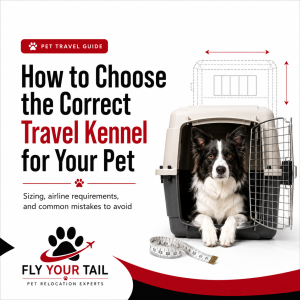
Choosing the travel kennel sounds like one of the easiest parts of pet relocation.
You measure the pet, buy a box, done.
Unfortunately, it is one of the things that causes the most problems at the airport.
I have seen owners buy a kennel based only on the dog’s weight, buy one because the pet technically “fits inside”, or order whatever size the pet shop recommends.
Then travel day comes and the airline says no.
The kennel is too small.
The ventilation is not correct.
The door is not suitable.
The dog cannot stand properly.
Or the airline has additional requirements for that particular breed.
So if your pet is going to travel by air, especially as accompanied baggage or manifested cargo, the kennel needs to be chosen properly.
Here is what I look at.
First: the kennel is based on your pet’s measurements, not their weight
This is probably the most important thing.
A 25 kg Bulldog and a 25 kg Labrador do not have the same body shape.
Neither do two dogs of the same breed.
Weight helps us understand the overall transport requirements, but it does not tell us what kennel size the pet needs.
The kennel has to give the animal enough room to stand, sit, turn around normally and lie down in a natural position. IATA uses these basic welfare criteria when determining whether a container is appropriately sized.
So when I ask a client for measurements, there is a reason.
I am not trying to make your life difficult with a tape measure.
The four measurements we normally need
For dogs, we normally start with four measurements.
A — Nose to base of tail
Measure from the tip of the nose to the base of the tail.
Not to the end of the tail.
B — Ground to elbow
Measure from the ground to the elbow joint.
C — Width across the shoulders
Measure the widest part of the pet.
For many dogs, this is across the shoulders.
D — Ground to the top of the head or ears
This is where people often underestimate the height.
Measure from the floor to the highest natural point when your pet is standing.
If the ears stand upright, the ears matter.
The pet should not have to crouch to fit inside the kennel.
IATA publishes a sizing formula based on these measurements for cats and dogs, and airlines use those dimensions as part of their acceptance process.
Your pet should be able to stand normally
This is the easiest test.
Put your pet inside the kennel.
Can they stand naturally?
Not:
“Technically yes, but they have to lower their head a little.”
That is not what we want.
The pet should be able to stand without the head, ears or body touching the roof.
They should also be able to turn around and lie down comfortably.
If I look at a photo and the dog’s ears are touching the roof, I am going to tell you that the kennel is too small.
Even if you have already bought it.
Bigger is not always automatically better
This surprises people too.
If the kennel is a little larger than the minimum required size, that is normally not a problem.
But buying a kennel that is massively oversized is not always useful.
It can create:
- Much higher cargo costs
- Difficulty fitting the kennel onto certain aircraft
- Problems with aircraft-door dimensions
- Reduced airline options
- More complicated ground transport
For manifested cargo, size matters financially because airlines often calculate freight using the kennel’s dimensional or volumetric weight.
So we want the kennel to be comfortably large enough, but we also want it to make logistical sense.
Why kennel size can completely change the relocation price
This is something clients often do not realise until they receive a cargo quote.
You may have a 30 kg dog.
But the airline may not charge you for 30 kg.
They may charge according to the space the kennel occupies.
A large kennel can therefore have a chargeable weight much higher than the actual combined weight of the dog and kennel.
This is why I always want accurate measurements before getting serious cargo pricing.
Changing from one kennel size to the next can sometimes make a surprisingly big difference to the freight cost.
It can even affect which aircraft can carry the pet.
The kennel also needs the correct construction
Size is only half of the story.
The kennel itself has to be appropriate for live-animal transport.
For standard dogs and cats, I check things like:
- Strong rigid construction
- Secure door
- Correct ventilation
- Water containers
- Strong fasteners
- No sharp internal edges
- Secure roof and base
- Suitable floor
- Appropriate handles or spacers
- No possibility of accidental opening
IATA’s Live Animals Regulations contain species-specific container requirements, including requirements around ventilation, security and safe handling.
And remember: airlines can apply their own additional rules on top of the general IATA requirements.
Please stop buying kennels because the website says “IATA approved”
This is one of my pet peeves.
You will see travel kennels advertised everywhere as:
IATA APPROVED
or
IATA CERTIFIED
That wording is misleading.
IATA publishes the Live Animals Regulations and container requirements, but the airline still decides whether it will accept the actual kennel and pet for that specific flight.
So I prefer to say:
IATA-compliant travel kennel
or:
Kennel prepared according to the applicable IATA Live Animals Regulations and airline requirements.
The airline makes the final acceptance decision.
Even if the manufacturer has printed a giant “AIRLINE APPROVED” sticker on the side.
Plastic kennels work for many pets
For many standard dogs and cats, a good-quality rigid plastic travel kennel is perfectly suitable.
These are the kennels most owners recognise immediately.
They are usually made from:
- Rigid plastic shell
- Metal door
- Ventilation openings
- Separate top and bottom sections
- Secure fasteners
But not every plastic kennel sold online is suitable for international air transport.
I still need to check:
- Door type
- Fasteners
- Ventilation
- Strength
- Dimensions
- Airline-specific requirements
A kennel being sold as a “pet carrier” does not mean an airline will accept it.
Some dogs need a reinforced kennel
Strong or powerful breeds can have completely different requirements.
Certain airlines require reinforced wooden or metal construction for particular breeds.
For example, Lufthansa Cargo introduced stricter kennel requirements from March 2026 for dogs covered by its strong-breed operator variation, including specific construction requirements for the frame and side walls.
This is why I need to know the exact breed before approving a kennel.
A standard plastic box that works perfectly for a Golden Retriever may not be accepted for another dog of exactly the same weight.
Brachycephalic pets need extra consideration
Flat-faced breeds need special attention when choosing a kennel.
This includes dogs such as:
- Pugs
- French Bulldogs
- English Bulldogs
- Boston Terriers
And brachycephalic cats such as:
- Persians
- Exotic Shorthairs
IATA’s current guidance calls for snub-nosed breeds to use a container that is 10% larger than the normal calculated requirement.
That additional space helps improve airflow around the animal.
But kennel size is only one part of planning a brachycephalic relocation.
The airline, temperature, route, transit and individual health of the pet are all extremely important too.
The door matters
I pay a lot of attention to the kennel door.
It needs to be strong and securely attached.
The animal should not be able to push it open.
There should not be large gaps where paws or noses can become trapped.
And depending on the airline, additional security measures may be required.
What I do not want is someone adding random padlocks or cable ties that prevent airline staff from accessing the pet in an emergency.
Always follow the airline’s actual instructions.
Ventilation matters more than people think
A travel kennel needs proper airflow.
IATA container guidance generally requires adequate ventilation, commonly on at least three sides for applicable live-animal containers, with species-specific requirements in the regulations.
Do not cover ventilation holes with:
- Blankets
- Labels
- Document envelopes
- Giant stickers
- Luggage
I know people want the kennel to feel cosy, but airflow is more important than making it look like a bedroom.
What goes inside the kennel?
Less than most people think.
Normally:
- Absorbent bedding
- Water bowls
- Possibly a small amount of familiar bedding, if permitted
I do not normally recommend filling the kennel with:
- Toys
- Hard objects
- Large blankets
- Loose leads
- Harnesses
- Anything the pet could become tangled in
Airlines can have specific rules about what is allowed inside.
For cargo travel especially, keep it simple.
Food and water bowls
The kennel should have water containers that can normally be accessed or refilled from outside without opening the main door.
This is particularly important during longer journeys or transits.
Food arrangements depend on:
- Journey length
- Airline
- Transit
- Pet age
- Medical requirements
For long itineraries, feeding instructions may travel with the kennel.
Again, this is something we plan before travel day, not while standing at cargo acceptance.
What about wheels?
Many large commercial kennels come with wheels.
Very convenient at home.
Less convenient on an aircraft.
Airlines commonly require wheels to be removed or made completely inoperable so the kennel cannot move unexpectedly.
If the model has detachable wheels, keep them for later.
You will be very happy to have them when you need to move a giant kennel through your new house.
Wooden kennels
Wooden custom kennels are sometimes necessary.
I usually consider them when:
- No commercial plastic kennel is large enough
- The dog is a strong breed
- The airline requires reinforced construction
- The dimensions need to be custom built
- The route has specific cargo requirements
They need to be built properly.
A homemade wooden box is not automatically suitable just because it is strong.
Ventilation, dimensions, door construction, hardware and safe internal surfaces all still matter.
Can two pets travel in one kennel?
Sometimes, but I would never assume this is automatically allowed.
IATA Container Requirement 1 includes specific conditions on when multiple compatible dogs or cats may share a container, including restrictions based on age and weight; animals above certain weights must be crated individually.
Airlines may be stricter.
For most adult pet relocations I organise, I prefer each pet to have their own correctly sized kennel unless the airline has specifically approved otherwise.
It also makes the planning much clearer.
Start crate training before travel
The best kennel in the world is not much help if your dog sees it for the first time at the airport.
Once we know which kennel the pet will use, I want it sitting at home.
Door open.
Blanket inside.
Treats inside.
Meals near it.
Let the pet explore it.
Then gradually start closing the door for short periods.
The goal is for the kennel to become boring.
Boring is excellent.
I do not want the kennel to mean:
“Something terrible is about to happen.”
I want it to mean:
“Oh, this thing again. Fine.”
Do not buy the kennel at the last minute
Please do not wait until three days before departure.
There are several reasons.
First, we need time to check the dimensions.
Second, the model may be wrong.
Third, your pet needs time to get used to it.
And fourth, especially for large dogs, the correct kennel may need to be ordered or custom built.
For complex cases, I prefer confirming the kennel well before the flight.
Send photos before travel
If I am managing your relocation, I will normally want photos.
Ideally:
- Pet standing inside the kennel
- Side view
- Front view
- Door
- Ventilation
- Fasteners
- Full kennel exterior
- Manufacturer label if available
This gives us a chance to identify obvious problems before the airline does.
I would much rather tell you two weeks before travel that the kennel needs changing than have the airline tell you two hours before departure.
The airline still has the final word
This is important enough to repeat.
I can measure the pet.
I can calculate the required dimensions.
I can review the kennel.
I can compare it against the applicable regulations and airline requirements.
But the airline makes the final acceptance decision.
IATA publishes the global Live Animals Regulations used as a basis for commercial air transport of live animals, while individual airlines can apply additional operator-specific requirements.
That is why we always check both.
So, what kennel should you buy?
My answer is always:
Measure the pet first.
Then look at:
- Required internal dimensions
- Breed
- Airline
- Travel method
- Route
- Aircraft
- Airline-specific requirements
And only then choose the kennel.
Not the other way around.
I know it is tempting to see a cheap kennel online and think:
“That looks about right.”
But the travel kennel is your pet’s space for the entire journey.
It is worth getting right.
How Fly Your Tail can help
When I manage a relocation, travel-kennel support can include:
- Pet measurement review
- Required kennel-size calculation
- Existing kennel assessment
- Airline requirement check
- Brachycephalic sizing review
- Strong-breed kennel requirements
- Custom kennel planning where necessary
- Pre-travel photo review
- Crate-training guidance
The aim is simple: by the time your pet reaches the airport, the kennel should not be a question mark.
Not sure whether your pet’s kennel is suitable?
Send me your pet’s breed, weight, measurements and photos of the kennel and I can review what they are likely to need for the planned journey.