
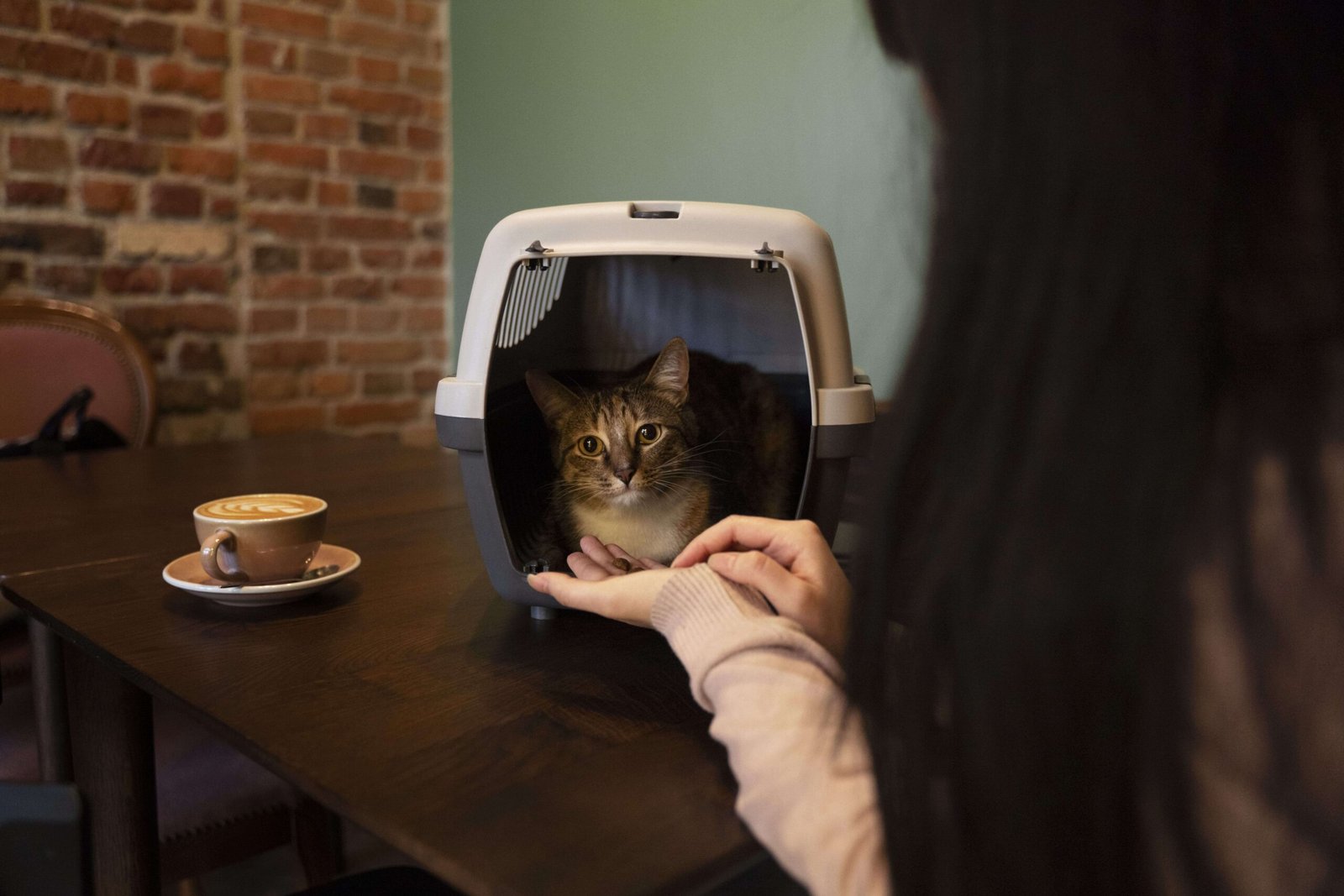
Would you feel comfortable taking your cat out of its carrier in the middle of a crowded airport, surrounded by hundreds of strangers, loud noises, security equipment and unfamiliar smells?
As a cat owner myself and a professional working in international pet relocation, I certainly wouldn’t.
However, this is a situation that passengers travelling with cats through Spanish airports can find themselves facing during airport security checks. A recent experience involving one of our customers at Fly Your Tail has made me want to address this issue publicly and ask AENA to reconsider how security inspections are conducted when passengers travel with animals.
A Real Fly Your Tail Case: Four Cats Travelling from Palma de Mallorca to Larnaca
One of our customers was travelling from Palma de Mallorca Airport (PMI), Spain, to Larnaca Airport (LCA), Cyprus, with four cats. During the airport security process, our customer was asked to open the cats’ travel carriers for inspection.
Concerned about the possibility of the cats escaping, our customer refused to open the carriers as requested. Following police involvement, the customer was permitted to proceed without complying with the original request.
Fortunately, in this particular case, the situation was resolved. However, it raises an important question:
Why should pet owners have to challenge an airport security procedure to protect their animals from a foreseeable risk?
The exact alternative inspection method used in this case has not been independently documented, but the outcome suggests that there was some flexibility in how the situation could be handled.
I completely understand the importance of airport security. I work in international logistics, and compliance with aviation regulations is a fundamental part of my profession. But I also believe that aviation security and animal welfare should be able to coexist.
Why Removing a Cat From Its Carrier at Airport Security Can Be Dangerous
Anyone who owns a cat knows how unpredictable their behaviour can become when they are frightened. Even the calmest and most affectionate cat at home can react completely differently in an unfamiliar environment.
An airport combines many of the things that can trigger fear and anxiety in cats:
- Hundreds of unfamiliar people.
- Loud announcements and sudden noises.
- Security alarms and scanning equipment.
- Unfamiliar smells.
- Other animals.
- Constant movement and activity.
- Stress associated with transportation.
A frightened cat can escape from its owner’s arms in seconds. Even a harness does not completely eliminate this risk.
Once a cat escapes inside a major international airport, finding it can become extremely complicated. Airports contain ventilation systems, baggage handling areas, service corridors, restricted operational zones and countless potential hiding places. Passengers cannot simply access these areas to search for their missing pets.
What begins as a routine security inspection can turn into weeks or even months of uncertainty for a family. Unfortunately, this is not just a hypothetical scenario.
Mici: The Cat That Spent 51 Days Lost Inside Madrid-Barajas Airport
In February 2026, Spanish newspaper La Vanguardia published an interview with Elena Andrés Rubio, an AENA employee who has worked at Madrid-Barajas Airport for more than twenty years and volunteers in animal rescue.
During the interview, she described the case of Mici, an Italian cat who escaped during an airport security inspection after being required to leave her carrier. Mici remained missing inside the airport for 51 days. Thanks to persistent search efforts and an informal network of people working within the airport, she was eventually located.
Fifty-one days.
As a pet owner, I cannot imagine the anxiety of travelling to another country while knowing that one of my cats is somewhere inside an airport, frightened and potentially inaccessible. The case demonstrates that removing a cat from its carrier in an unsuitable environment is not a risk that should be underestimated.
Source: La Vanguardia, 3 February 2026
Locky: Another Cat Lost at Madrid-Barajas Airport in 2026
On 3 February 2026, another cat named Locky escaped at Terminal 4 of Madrid-Barajas Airport. According to the Spanish animal welfare foundation FAADA, Locky was a four-year-old cat travelling with his family. He escaped while his owners were attempting to administer medication prescribed by their veterinarian before passing through airport security.
Although this incident did not occur during the security inspection itself, it highlights the consequences of opening a cat carrier inside an airport.
On 12 February 2026, FAADA publicly requested cooperation from AENA and the relevant authorities to facilitate an organized search. The organization also raised concerns about the availability and effectiveness of procedures for recovering animals that escape inside airport facilities.
This raises another important issue: airports need not only preventive measures but also clear emergency procedures when an animal goes missing.
Source: FAADA, 12 February 2026
Animal Welfare Organizations Have Been Raising This Issue Since 2015
While researching this topic, I discovered that concerns about airport security procedures involving cats are not new. In February 2015, the animal protection organization La Gatera launched a petition addressed to AENA. The petition requested safer inspection procedures for passengers travelling with pets, particularly cats.
It proposed that animals remain inside their carriers during inspections where an approved screening method permits this, or that any necessary removal take place inside a secure, enclosed area.
More than a decade later, the experience of our customer in Palma de Mallorca shows why this conversation remains relevant.
How Other International Airports Handle Security Checks With Cats
One of the most frustrating aspects of this situation is that safer alternatives already exist.
Frankfurt Airport, Germany
Frankfurt Airport provides a particularly interesting example of how aviation security and animal welfare can be addressed together. According to its official passenger information, pets travelling in the cabin receive an additional inspection in a dedicated room located beyond the regular security checkpoint, with their owner present. This allows the necessary inspection to be conducted in a more controlled environment.
Frankfurt is one of Europe’s largest international aviation hubs. Its approach demonstrates that dedicated animal inspection procedures can be integrated into the operations of a major international airport.
Airports in the United States
In the United States, the Transportation Security Administration (TSA) allows passengers to request private screening arrangements when travelling with animals that may become frightened or difficult to control. A TSA spokesperson has specifically recommended private screening for cats when there is a concern about keeping them securely restrained.
The necessary security procedures still take place, but the animal can be handled in a more controlled environment. These examples show that protecting animals does not necessarily require compromising aviation security.
Is It Mandatory to Remove Your Cat From Its Carrier at Spanish Airport Security?
This is where the situation becomes less clear. Airport security personnel must conduct the required inspections of passengers, animals and their belongings.
However, I have not found a publicly available AENA policy guaranteeing passengers access to a private, enclosed room for pet security inspections across all Spanish airports. Nor have I established that the applicable regulations require a cat to be removed from its carrier specifically in an open, crowded passenger area.
There is an important difference between requiring an animal to undergo security screening and requiring that screening to take place in an environment where the animal could escape.
Our customer’s experience in Palma de Mallorca suggests that alternative arrangements may be possible in certain circumstances. However, this does not establish a general legal right to refuse security screening or to insist that an animal remains inside its carrier. This is precisely why clearer public guidance from AENA and the relevant aviation security authorities would be valuable.
AENA – Official information on travelling with animals
What Should You Do When Travelling With a Cat Through Airport Security?
If you are planning to travel internationally with your cat, particularly through a Spanish airport, I recommend taking the following precautions.
1. Contact the airport before travelling
Ask how cats travelling in the passenger cabin are inspected and whether private screening arrangements are available. Where possible, request written confirmation.
2. Request a private screening room
Before opening your cat’s carrier, explain to security personnel that your animal could become frightened and escape. Politely request that any necessary removal takes place inside a secure, enclosed room. You can use the following phrase in Spanish:
“Mi gato puede asustarse y escaparse. ¿Sería posible realizar la inspección en una sala cerrada y segura?”
3. Use a secure, airline-compliant carrier
Make sure the carrier is in good condition and that all zippers, fastenings and openings are secure. Introduce your cat to the carrier well before the journey. If your cat will travel in the hold or as cargo instead, see our IATA-compliant travel kennel support.
4. Consider an escape-resistant harness
A properly fitted harness may provide additional protection during handling if your cat is already comfortable wearing one. However, no harness is completely escape-proof. It should not be considered a substitute for an enclosed inspection area.
5. Ask to speak to a security supervisor if necessary
If you are concerned that the proposed inspection could put your cat at risk, calmly explain your concerns and ask whether an approved alternative is available. Always cooperate with lawful security requirements.
6. Never place a live animal inside a baggage X-ray machine
Baggage screening equipment is not intended for live animals. Make sure security personnel know that your carrier contains a cat before placing anything on the screening conveyor.
7. Keep identification and veterinary records up to date
Ensure your cat is microchipped and that your contact information is current wherever the microchip is registered. Keep recent photographs of your cat on your phone. Although microchips are not GPS trackers, they can help identify and reunite missing animals with their families.
Planning the whole trip? See our guide to what documents are required for international pet travel, our step-by-step guide to flying your pet internationally. Entry rules also change, so read what’s changing for dogs and cats in 2026–2027.
An Open Request to AENA From Fly Your Tail
As the founder of an international pet relocation company, a Spanish citizen and an animal owner, I would like to encourage AENA and the relevant aviation security authorities to review their procedures for passengers travelling with animals.
At Fly Your Tail, we would welcome the introduction of:
- Dedicated, enclosed rooms for animal security inspections.
- Standardized pet screening procedures across Spanish airports.
- Specific training for security personnel on animal handling and escape prevention.
- Clear information for passengers before their departure.
- Approved alternative screening methods where appropriate.
- Formal emergency response protocols for animals that escape inside airports.
- Better coordination between airport operators, airlines, security personnel and animal rescue organizations.
We are not asking for exceptions to aviation security regulations. We are asking for the necessary security checks to be carried out in a way that also takes animal welfare into consideration.
If international airports such as Frankfurt can establish dedicated procedures for inspecting animals, surely it is worth exploring similar arrangements across Spanish airports.
A cat should not have to go missing before its safety becomes a priority.
Frequently Asked Questions About Flying With Cats Through Spanish Airports
Do I have to take my cat out of its carrier at airport security in Spain?
You may be asked to remove your cat so that its carrier can be inspected. Procedures may vary, so contact your departure airport in advance and request a secure screening environment.
Can I request a private room for my cat’s security inspection?
Yes, you can request one. However, I have not established that access to a private inspection room is guaranteed across all airports operated by AENA.
Can I refuse to take my cat out of its carrier?
You can explain your safety concerns and request an approved alternative. However, you should not assume that refusing an inspection entitles you to proceed through airport security.
Can my cat go through an airport baggage X-ray machine?
No. Live animals should never be placed inside equipment intended for screening baggage.
Can a cat escape from a harness at the airport?
Yes. A frightened cat may escape even from a well-fitted harness. A secure, enclosed room is a more reliable way of reducing the risk during carrier removal.
What should I do if my cat escapes inside an airport?
Immediately inform airport security, the airport operator and your airline. Provide recent photographs, microchip details and the last known location. Request that a coordinated search be initiated. Never enter restricted airport areas without authorization.
Final Thoughts: Pets Are Family, Not Luggage
I founded Fly Your Tail after experiencing firsthand how complicated and emotionally demanding international pet relocation can be. Today, my work involves airline regulations, veterinary documentation, international logistics, customs procedures and some of the most complicated animal relocations.
But beyond all the paperwork, bookings and operational challenges, there is always a living animal and a family that loves it. As someone who shares her home with both dogs and cats, I know how much trust families place in everyone involved in their pets’ journeys.
I believe our responsibility as professionals goes beyond organizing transportation. It also means identifying unnecessary risks, questioning procedures that could be improved and advocating for better standards of animal welfare. I hope AENA will consider this issue and work towards a safer, more consistent approach to animal security inspections across Spain.
If you have travelled with a cat through a Spanish airport and experienced a similar situation, I would love to hear from you. The more we share our experiences, the better we can understand where improvements are needed.
Airport security and animal welfare should never be mutually exclusive.
Travelling with your cat soon? Request a quote and we will help you plan the journey.