

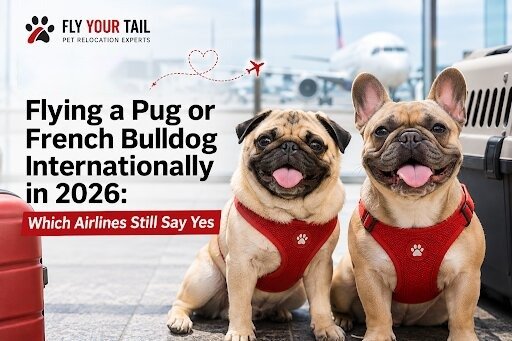
If you own a Pug or French Bulldog and are planning an international move, you may have already discovered something frustrating: finding an airline willing to transport your dog can be surprisingly difficult. Many major airlines restrict or refuse brachycephalic (short-nosed) breeds, particularly when they must travel in the aircraft hold.
But does that mean your French Bulldog or Pug cannot fly internationally in 2026? Not necessarily. Although airline restrictions have become increasingly strict, several travel options remain available depending on your dog’s size, health, route, season, and the airline’s current policies.
At Fly Your Tail, we specialize in complex international pet relocations, including cases involving brachycephalic breeds that other relocation companies may decline. In this guide, we’ll explain which airlines may still accept Pugs and French Bulldogs, the differences between cabin and cargo transport, and what to consider before planning your dog’s journey.
Why Do Airlines Restrict Pugs and French Bulldogs?
Pugs and French Bulldogs belong to a group of breeds known as brachycephalic dogs, meaning they have shortened skulls and relatively flat faces. Other examples include English Bulldogs, Boston Terriers, Pekingese, and certain Mastiff breeds. Their distinctive facial anatomy can make breathing more difficult, particularly during stressful situations or exposure to high temperatures.
Some brachycephalic dogs suffer from Brachycephalic Obstructive Airway Syndrome (BOAS), which can affect their ability to breathe and regulate body temperature efficiently. During air travel, several factors may increase the risks:
- Stress associated with unfamiliar environments, handling, and confinement.
- Exposure to elevated temperatures during ground handling.
- Changes in cabin pressure and environmental conditions.
- Long waiting periods before departure or after arrival.
- Existing respiratory or cardiovascular conditions.
Because of these risks, many airlines have introduced breed-specific restrictions. However, an airline refusing a French Bulldog as checked baggage does not necessarily mean it refuses the same breed as manifested cargo. Understanding that distinction is essential.
Can Pugs and French Bulldogs Fly in the Cabin?
Yes. Some airlines continue to accept Pugs and French Bulldogs in the passenger cabin, provided they comply with the airline’s weight, carrier, and route requirements. For many airlines, the combined weight of the dog and its carrier must not exceed 8 kg (17.6 lb). This may be possible for a small Pug, but it is more difficult for an adult French Bulldog, which frequently exceeds the cabin weight limit.
Airlines that may accept eligible small brachycephalic dogs in the cabin include:
- Lufthansa
- Air France
- KLM
- Turkish Airlines
- Finnair
- Air Canada
Cabin acceptance must always be confirmed for the particular breed, operating airline, route, and flight.
Important: Even when a dog meets the weight limit, the carrier must fit beneath the seat and allow the animal to move comfortably. Weight alone does not guarantee acceptance.
Which Airlines Still Transport Pugs and French Bulldogs in 2026?
Airline policies vary significantly depending on whether the dog travels in the passenger cabin, as accompanied checked baggage, or as manifested cargo. Here are several important airlines to consider.
1. Lufthansa and Lufthansa Cargo
Lufthansa accepts eligible small dogs in the passenger cabin, subject to its published weight and carrier restrictions. However, Lufthansa’s passenger baggage service restricts brachycephalic breeds from travelling in the hold.
Lufthansa Cargo is a separate service with its own live-animal procedures and breed-specific restrictions. Its published cargo guidance discusses temperature restrictions and additional welfare assessments for snub-nosed dogs.
What this means for owners: Lufthansa passenger services and Lufthansa Cargo must be evaluated separately. Cargo acceptance is not automatic and may be affected by additional embargoes, route restrictions, and seasonal conditions.
2. Turkish Airlines and Turkish Cargo
Turkish Airlines may accept eligible small Pugs and French Bulldogs in the passenger cabin. For dogs exceeding cabin limits, accompanied baggage restrictions must be distinguished from the separate cargo service.
Turkish Cargo may be worth investigating for complex brachycephalic relocations, but acceptance requires direct confirmation of the breed, route, aircraft, crate, and current operating restrictions. For international journeys involving connections through Istanbul, the complete transit arrangement must also be reviewed.
3. Etihad Cargo
Etihad Cargo is particularly relevant for owners researching specialist transport options for brachycephalic breeds. The airline announced a seasonal acceptance policy for short-nosed dogs and cats between 1 November and 1 March.
These shipments require additional documentation, checks, and approval by Etihad Cargo’s live-animal specialists. This makes Etihad Cargo an option worth investigating during the cooler months, subject to current availability and acceptance conditions.
4. Air France
Air France accepts eligible small dogs in the cabin, subject to its weight, carrier, and booking requirements. However, brachycephalic breeds face restrictions on transport in the aircraft hold.
Owners of larger French Bulldogs should not assume that the airline’s standard pet transport service will be available. Any separate cargo solution must be verified directly before making travel arrangements.
5. KLM
KLM accepts eligible small dogs in the cabin. Its published policy specifically lists Bulldogs and Pugs among breeds that cannot travel as checked pets in the hold.
KLM refers owners to cargo arrangements for certain situations, but this does not establish that every brachycephalic breed will be accepted by its cargo partners. A French Bulldog or Pug requiring manifested cargo needs a separate acceptance assessment.
6. Finnair
Finnair publishes options for pets travelling in the cabin, aircraft hold, and as cargo. Its standard cabin limit is 8 kg including the carrier.
However, its general pet policy should not be interpreted as guaranteed approval for brachycephalic breeds. Owners should request written confirmation of breed acceptance for the specific flight and transport method.
7. Air Canada
Air Canada accepts eligible small dogs in the passenger cabin. Its policy specifically excludes short-nosed dog breeds from the baggage compartment because of their increased susceptibility to respiratory difficulties and heat-related complications.
Owners of larger Pugs or French Bulldogs should therefore investigate other arrangements rather than assuming checked baggage is available.
What About Airlines That Refuse Snub-Nosed Dogs?
Several airlines impose strict restrictions on brachycephalic breeds. These restrictions may apply to checked baggage, cargo, or both.
For example, Alaska Air Cargo publishes restrictions on brachycephalic breeds in the cargo compartment, including Bulldogs and Pugs. Vietnam Airlines also publishes a breed-specific acceptance list that restricts French Bulldogs and Pugs in certain passenger pet transport categories. Moving a dog to or from Vietnam? See our pet relocation services in Vietnam.
Never assume that an airline accepting dogs generally will accept a French Bulldog or Pug. The breed must be checked separately against the specific transport service.
What Is the Difference Between Checked Baggage and Manifested Cargo?
This distinction is especially important when transporting brachycephalic dogs.
Accompanied checked baggage
Your dog travels in an approved kennel in the aircraft hold, generally on the same flight as you. The booking is linked to your passenger reservation. Many airlines prohibit Pugs and French Bulldogs from travelling this way.
Manifested cargo
Your dog travels under an air waybill as a live-animal shipment. The transport is arranged through the airline’s cargo division, often with the assistance of a specialized pet relocation company or freight forwarder.
Manifested cargo involves separate acceptance procedures, documentation, handling arrangements, and potentially customs clearance. Some cargo operators have specialist procedures for brachycephalic breeds.
However, manifested cargo is not automatically safer or more suitable. The individual dog’s health, route, handling conditions, and airline procedures must be carefully assessed. To see how this service works for short-nosed and other restricted dogs, read our guide to manifested cargo for restricted breeds.
Can a French Bulldog Fly Internationally If It Weighs More Than 8 kg?
Potentially, yes. For larger French Bulldogs that cannot travel in the passenger cabin, the remaining possibilities may include:
- A specialist manifested cargo service that explicitly accepts the breed.
- A private or shared charter arrangement, subject to operator approval.
- A combination of air travel and road transport.
- An alternative route through countries with more suitable transport arrangements.
The right solution depends on the destination, season, available services, and the dog’s veterinary assessment. Some journeys may not be advisable, even if a transport option is technically available.
How to Prepare a Pug or French Bulldog for International Air Travel
Preparation is particularly important for brachycephalic breeds.
- Arrange a veterinary assessment. Discuss respiratory health, exercise tolerance, any history of breathing difficulties, and whether air travel is appropriate. A veterinarian familiar with brachycephalic breeds may recommend further assessment.
- Choose the correct travel kennel. For cargo travel, the kennel must comply with the applicable IATA Live Animals Regulations and any additional airline requirements. Adequate ventilation and space are essential.
- Consider the season. High temperatures can increase transport risks. Cooler travel periods may offer more suitable operating conditions, but temperature restrictions must be checked at departure, transit, and destination airports.
- Minimize unnecessary connections. Whenever feasible, choose routes that reduce handling, prolonged waiting periods, and exposure to unsuitable conditions.
- Prepare veterinary and government documentation early. Requirements may include microchipping, rabies vaccination, blood tests, import permits, and official veterinary health certificates.
- Avoid routine sedation. Sedatives can increase respiratory and cardiovascular risks. They should not be used simply to make a dog calmer during air travel. Follow veterinary advice and the airline’s applicable restrictions.
The veterinary health certificate, also called a pet travel certificate, is a key part of pet export documentation.
For a full checklist, see our guide to what documents are required for international pet travel.
What If Every Airline Says No?
This is where specialist pet relocation planning can make a difference. Sometimes the problem is not that the dog cannot travel internationally. It is that the proposed airline, route, season, or transport method is unsuitable. An alternative might involve changing the departure airport, using another cargo operator, travelling during a cooler period, or combining air and ground transport.
At Fly Your Tail, we regularly investigate difficult international pet transport cases involving restricted breeds, unusual routes, and complicated import requirements. We understand that finding a workable solution often requires extensive research, coordination with multiple airlines, and careful regulatory planning.
But we also believe that animal welfare must come before completing a shipment. If a journey cannot be arranged responsibly, we would rather explain why than expose a pet to unnecessary risk. If you are comparing providers, read our guide on how to choose a reliable pet relocation company.
Why Choose Fly Your Tail for Brachycephalic Dog Relocation?
Fly Your Tail is an EU-registered international pet relocation consultancy specializing in complex animal transport. Founded by Julia Ortiz, a former shipping manager who began the company after personally relocating her own dogs, Fly Your Tail combines professional logistics experience with a pet-first approach.
We help owners navigate:
- Airline and cargo acceptance policies for restricted breeds.
- International route planning and alternative transport options.
- Veterinary documentation and import/export requirements.
- IATA-compliant kennel selection and preparation.
- Coordination with trusted handling and customs partners.
- Pre-departure planning, shipment monitoring, and arrival arrangements.
We are particularly interested in the cases that other relocation companies may be unable or unwilling to handle. Whether you are relocating a French Bulldog from Europe to Asia, a Pug from North America to South America, or another brachycephalic dog on a challenging international route, we can investigate the available options. Because pets are family, not cargo.
Frequently Asked Questions
Can French Bulldogs fly internationally in 2026?
Yes, some French Bulldogs can travel internationally, but available options depend on their size, health, destination, airline restrictions, and transport method. Many airlines prohibit them from travelling as checked baggage.
Which airlines allow Pugs in the cabin?
Airlines including Lufthansa, Air France, KLM, Turkish Airlines, Finnair, and Air Canada may accept eligible small Pugs in the cabin. Breed acceptance, carrier dimensions, weight limits, and route restrictions must be checked before booking.
Can a French Bulldog travel as manifested cargo?
Some specialist cargo operators may consider brachycephalic dogs under specific conditions. Acceptance is not guaranteed and requires confirmation of the airline’s current policies, the dog’s veterinary suitability, and the proposed route.
Are Pugs banned from flying?
No. Pugs are not universally banned from air travel. However, many airlines restrict them from travelling in the aircraft hold, and some routes may have no suitable commercial air transport option.
Is it safe for a French Bulldog to fly?
Air travel presents additional risks for brachycephalic dogs, particularly those with respiratory problems. A veterinary assessment and careful evaluation of the journey are essential. No airline or relocation company can guarantee risk-free travel.
Can my French Bulldog fly without me?
Potentially. Where permitted, a French Bulldog may travel as manifested cargo without its owner on the same flight. This depends on breed acceptance, destination rules, and the available transport arrangements.
What is the best time of year to fly with a Pug?
Cooler periods may reduce heat-related risks, but the best travel window depends on the complete route and airline restrictions. Some specialist cargo services apply seasonal acceptance policies.
Can a pet relocation company help when airlines refuse my dog?
Yes. A specialist relocation company can investigate alternative airlines, cargo services, routes, and ground transport combinations. However, not every relocation will be feasible or appropriate for the dog’s welfare.
Need Help Flying Your Pug or French Bulldog Internationally?
Has an airline refused to transport your French Bulldog or Pug? Don’t give up before exploring the alternatives. At Fly Your Tail, we specialize in complex international pet relocation and can help you investigate the options available for your dog’s journey. Our global pet relocation support covers routes worldwide, and you can request a quote to check whether your dog’s route is possible before you commit.
Contact us with your dog’s breed, weight, departure country, destination, and preferred travel dates. We’ll help you understand what may be possible and which arrangements deserve further investigation.
Important: Airline policies and cargo embargoes can change without notice. This article is an informational guide updated in November 2026, not a guarantee of airline acceptance. All proposed shipments require current confirmation from the operating carrier and an appropriate veterinary assessment.