
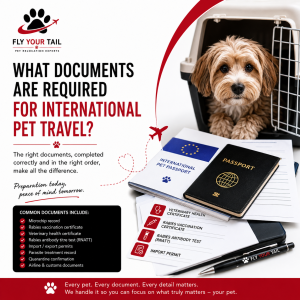
This is probably one of the questions I get asked the most.
And the annoying answer is:
It depends.
There is no single “pet travel document” that works everywhere.
What your pet needs depends on:
- The country they are leaving
- The country they are entering
- Their species
- Their age
- Their rabies vaccination history
- Whether they are travelling with you or separately
- Whether the move is considered personal or commercial
- Whether they are travelling in cabin, as accompanied baggage or as manifested cargo
- Whether there is a transit country involved
For some routes, the paperwork is quite simple.
For others, you may need months of preparation, blood tests, government permits, quarantine bookings and official veterinary certificates.
So rather than giving you one generic checklist, I am going to explain the documents that come up most often and when they may be needed.
1. Microchip record
For many international relocations, the microchip is the starting point.
The number should appear consistently across the pet’s:
- Vaccination record
- Rabies certificate
- Laboratory results
- Health certificate
- Import permit
- Airline documents
For many destinations, the qualifying rabies vaccination must be given after the microchip is implanted.
This is one of those small details that can cause a massive problem later.
If the rabies vaccine was given before the microchip, some countries may not accept it for travel purposes.
So before doing anything else, I always want the microchip scanned and checked.
2. Rabies vaccination certificate
Most countries require dogs and cats to have a valid rabies vaccination.
The record should normally include:
- Microchip number
- Vaccination date
- Vaccine name
- Manufacturer
- Batch number, where required
- Validity date
- Veterinarian details
Some countries also care about the sequence very precisely.
For example, the pet may need to be microchipped first, then vaccinated, then wait a certain number of days before travel or blood testing.
The European Union requires dogs, cats and ferrets entering under the non-commercial pet rules to be identified and appropriately vaccinated against rabies.
3. Rabies antibody titre test or RNATT
Not every pet needs this.
But if your pet is travelling from certain higher-risk rabies countries, a rabies antibody test may be required.
You may hear it called:
- RNATT
- Rabies titre test
- Rabies neutralising antibody test
- FAVN test
The blood sample is sent to an approved laboratory to check whether the pet has developed enough antibodies after vaccination.
The result commonly needs to be at least 0.5 IU/ml, but the rules around timing and accepted laboratories vary by destination.
For example, some EU imports require a three-month wait after the blood sample.
Japan requires pets from non-designated regions to arrive only after at least 180 days have passed from the rabies antibody blood-sampling date.
Australia also uses strict rabies-preparation requirements and a 180-day waiting period in applicable cases.
This is exactly why I never assume one rabies titre result is automatically valid everywhere.
4. Veterinary health certificate
This is one of the most important documents in international pet travel.
The veterinary health certificate is normally completed shortly before departure and confirms that the pet meets the destination’s health requirements.
It can include:
- Owner details
- Pet description
- Microchip number
- Vaccination information
- Rabies details
- Laboratory results
- Parasite treatments
- Clinical examination
- Fitness to travel
- Origin and destination
- Transport details
Depending on the country, the certificate may need to be:
- Completed by a private veterinarian
- Signed by an authorised veterinarian
- Endorsed by a government veterinarian
- Issued within a specific number of days before travel
This is not something I like leaving until the last minute.
The appointment needs to be timed properly because the certificate may only be valid for a limited period.
5. Government endorsement
A private veterinarian signing the document is not always enough.
Some countries require the health certificate to be officially endorsed by the veterinary authority in the country of export.
That could be:
- USDA in the United States
- APHA in Great Britain
- The relevant government veterinary authority in an EU country
- Another competent national authority
The exact process varies.
Sometimes it is electronic.
Sometimes original documents must physically move between the vet and the government office.
Sometimes it can take several days.
So this needs to be built into the timeline.
6. Import permit
Some destinations require an import permit before the pet can travel.
This is common for more regulated destinations.
Examples include:
- Australia
- New Zealand
- Singapore
- United Arab Emirates
- South Africa
- India in certain cases
Australia requires eligible imported cats and dogs to meet the applicable import conditions and, for relevant categories, travel with a valid biosecurity import permit.
An import permit may require:
- Microchip details
- Vaccination records
- Rabies titre result
- Owner information
- Destination address
- Quarantine booking
- Flight details
- Government fees
- Supporting declarations
A permit may also be valid only for a certain period.
So again, timing matters.
7. Export permit or export health approval
Some countries also require paperwork before the pet is allowed to leave.
This can include:
- Export permit
- Veterinary export certificate
- Government quarantine certificate
- Customs export declaration
- Official inspection
The destination may not require it, but the country of departure might.
That is why pet relocation is never only about the destination.
You have to satisfy both sides.
8. EU pet passport
If your pet already has a valid EU pet passport, it can make travel within the European Union much easier.
The passport records things like:
- Microchip
- Rabies vaccination
- Owner details
- Veterinary treatments
But an EU pet passport is not a universal travel document for every route.
It does not automatically replace:
- Import permits
- Rabies titre requirements
- Third-country health certificates
- Airline documents
- Commercial certificates
For pets entering the EU from outside the EU, an EU animal health certificate may be required instead, depending on the case.
9. EU animal health certificate
This is used for certain pets entering the EU from non-EU countries.
It contains information about:
- Pet identity
- Microchip
- Rabies vaccination
- Rabies antibody testing where applicable
- Owner declaration
- Veterinary certification
It is not the same thing as an EU pet passport.
This causes a lot of confusion.
Someone may say:
“My dog has a vaccination book, so that should be enough.”
Usually it is not.
The exact entry document matters.
10. CDC Dog Import Form for the United States
If you are bringing a dog into the United States, CDC requirements may apply in addition to airline and state rules.
As of 2026, all dogs entering or returning to the U.S. need a CDC Dog Import Form receipt.
For dogs that have only been in rabies-free or low-risk countries during the previous six months, that form may be the only CDC document required, although the dog must still meet the other CDC entry conditions.
Dogs coming from high-risk rabies countries can need additional vaccination, microchip, rabies serology and certification documents.
So “I am going to the USA” is not enough information.
I also need to know where the dog has been during the previous six months.
11. Advance notification
Some destinations require you to tell the government in advance that the pet is coming.
Japan is a good example.
Japan requires advance notification to Animal Quarantine Service at least 40 days before the intended arrival date.
This is separate from:
- The rabies test
- The health certificate
- The airline booking
- The arrival inspection
Again, one journey can involve several different approvals.
12. Quarantine reservation
For countries with mandatory quarantine, you may need a confirmed booking before the pet can travel.
Examples can include:
- Australia
- New Zealand
- Singapore in applicable cases
The quarantine confirmation may also be needed as part of the import permit application.
This is why I never recommend booking the flight before quarantine availability is checked.
If there is no space, the whole travel date can change.
13. Parasite treatment record
Some countries require specific parasite treatment before arrival.
The most well-known example is the tapeworm treatment required for many dogs entering Great Britain.
Other destinations may require:
- Internal parasite treatment
- External parasite treatment
- Tick treatment
- Heartworm prevention
- Specific veterinary products
The timing can be very strict.
A treatment performed too early or too late may not be accepted.
The veterinarian normally records:
- Product
- Active ingredient
- Date
- Time
- Signature
14. Additional disease test results
Some destinations require additional veterinary testing depending on the origin country.
Tests may include:
- Brucella canis
- Leishmania
- Babesia
- Trypanosoma
- Dirofilaria
- Leptospirosis
- Ehrlichia
South Africa is a good example of a destination where the disease panel can vary significantly depending on the country of export.
This is why copying another person’s checklist from Facebook is not a good idea.
Two dogs travelling to the same country can have different requirements because they are coming from different origins.
15. Non-commercial declaration
Some countries distinguish between a personal pet travelling with its owner and an animal being imported for:
- Sale
- Adoption
- Breeding
- Transfer of ownership
- Commercial purposes
For non-commercial travel, you may be asked to sign a declaration confirming that the pet is not being sold or transferred.
The owner may also need to travel with the pet or within a specified number of days.
This matters particularly in the EU and UK.
If the movement is actually commercial, a completely different set of rules may apply.
16. Proof of ownership
Some countries or customs authorities may ask for evidence that the pet belongs to you.
This could include:
- Pet passport
- Microchip registration
- Veterinary records
- Purchase or adoption documents
- Previous travel documents
For India, for example, the owner’s immigration status and relationship with the pet can be very important when determining whether the movement qualifies under transfer-of-residence rules.
17. Owner passport and visa copies
These are commonly requested for:
- Import permits
- Customs clearance
- Cargo bookings
- Quarantine reservations
- Non-commercial declarations
Depending on the destination, you may also need:
- Residence visa
- Work permit
- Immigration approval
- Local address
- Flight ticket
The pet paperwork and the owner paperwork often connect.
18. Airline booking confirmation
The airline will also have its own documents.
These may include:
- Pet booking confirmation
- Special service request
- Cargo reservation
- Air waybill
- Feeding instructions
- Live-animal declaration
- Shipper declaration
- Kennel labels
The airline documents do not replace the government documents.
And the government documents do not automatically guarantee airline acceptance.
Both sides need to work.
19. Air waybill for manifested cargo
If your pet travels as manifested cargo, the shipment is normally booked under an air waybill, or AWB.
This document identifies:
- Shipper
- Consignee
- Origin
- Destination
- Airline
- Shipment details
- Weight
- Routing
The AWB is important for:
- Airline handling
- Customs clearance
- Destination release
- Shipment-status monitoring
It is one of the main operational documents in a cargo relocation.
20. Customs documents
Cargo arrivals often involve customs paperwork as well.
Depending on the destination, this may include:
- Customs declaration
- Import entry
- Proof of value
- Owner declaration
- Tax or duty documents
- Broker authorisation
- Importer information
Veterinary clearance and customs clearance are separate things.
Your pet may have passed the veterinary inspection but still be waiting for customs release.
21. Transit documents
One of the easiest things to forget is the transit country.
Your pet may be going from Country A to Country C, but if they transit through Country B, we still need to ask:
Does Country B have any requirements?
The answer depends on things like:
- Whether the pet stays airside
- Whether the airline changes
- Whether the AWB changes
- Whether there is an overnight stay
- Whether the pet enters the country
- Whether the airport requires a transit permit
A passenger may be able to make a connection without a visa while the pet still requires completely different paperwork.
22. Original documents versus copies
This one causes unnecessary panic.
Some destinations accept electronic documents or copies.
Others want originals.
Some airlines want copies attached to the kennel while the original stays with the owner.
Some cargo agents need originals before release.
So before travel, I like to know:
- What travels with the pet
- What travels with the owner
- What is sent to the destination agent
- What needs to be original
- What can be digital
I normally recommend keeping a complete digital backup as well.
So, what documents does your pet actually need?
For a fairly straightforward international move, you might need:
- Microchip record
- Rabies vaccination certificate
- Routine vaccination record
- Veterinary health certificate
- Owner passport
- Airline booking
For a more regulated move, you could also need:
- Rabies titre test
- Import permit
- Export permit
- Government endorsement
- Advance notification
- Quarantine confirmation
- Parasite-treatment record
- Additional blood tests
- Customs documents
- Air waybill
- Transit permit
And that is before we start talking about unusual species, rescue animals, commercial movements or complicated multi-country routes.
This is why I always check the route first
I would never tell someone:
“These are the documents all pets need.”
Because that is simply not true.
The correct order is:
- Confirm origin and destination
- Check the pet’s species and breed
- Review microchip and vaccination history
- Determine whether rabies testing is required
- Check import and export permits
- Check owner-travel rules
- Review airline and transit requirements
- Build the veterinary timeline
- Prepare the final certificates
- Check every document again before travel
The paperwork may look intimidating at first, but once it is put into the correct order, it becomes much easier to manage.
How Fly Your Tail can help
When I manage an international relocation, document support can include:
- Microchip and vaccination review
- Rabies titre test planning
- International veterinary sample logistics
- Import permit applications
- Export-document preparation
- Health certificate instructions
- Government endorsement coordination
- Quarantine documents
- Airline paperwork
- Cargo documentation
- Customs and destination-agent coordination
- Final pre-travel document review
I personally keep track of the requirements and timing for the case so that the owner does not have to work out which document needs to happen next.
Because honestly, moving country is stressful enough without spending your evenings trying to understand ten different government websites.
Planning an international move with your pet?
Send me your pet’s details, origin, destination and preferred travel date and I can assess which documents and veterinary steps will be required.