
This is one of the first things I explain to almost every client because the terminology is confusing.
People often tell me:
“I want my dog to travel as baggage, not cargo.”
Or:
“Can’t I just check the kennel in like a suitcase?”
Or:
“Cargo sounds scary. Is there another option?”
The truth is that there are three main ways a pet can travel by air, and none of them is automatically “better” in every situation.
It depends on:
Your pet’s size
Breed
Airline
Route
Destination-country rules
Aircraft
Whether you are travelling with the pet
Seasonal restrictions
The kennel required
So here is the simple version.
1. Pet in cabin
This is normally the option owners prefer when it is available.
Your pet travels with you in the passenger cabin inside an airline-approved carrier.
Usually this option is limited to small dogs and cats.
The airline will normally have limits for:
- Pet weight
- Carrier weight
- Carrier dimensions
- Number of pets permitted per flight
- Species
- Breed
- Seat location
Some airlines calculate the limit as pet + carrier combined.
Others have slightly different rules.
And even if an airline generally accepts pets in cabin, that does not mean it accepts them on every route.
What cabin travel normally looks like
You arrive at the passenger terminal with your pet.
At check-in, the airline may:
- Check the pet booking
- Weigh the pet and carrier
- Measure the carrier
- Review the travel documents
- Confirm the route and destination requirements
The pet normally stays inside the carrier during the flight.
At security, you may be asked to remove the pet while the carrier goes through the X-ray machine.
If you have a nervous cat, please ask whether a private security room is available.
Opening a cat carrier in the middle of a busy airport is not something I recommend.
The advantage of cabin travel
The obvious advantage is that your pet stays physically close to you.
For many owners, that makes the journey feel much easier.
It can also involve:
- Simpler airport handling
- No cargo terminal
- No air waybill
- Lower cost in some cases
But cabin travel is not always possible.
Cabin travel is not only about weight
This is something people misunderstand all the time.
A client might tell me:
“My dog is only 8 kg, so surely he can travel in cabin.”
Maybe.
Maybe not.
The question is not only whether the dog weighs 8 kg.
The pet also needs to fit comfortably in a carrier that meets the airline’s cabin dimensions.
A tall 8 kg dog may not fit under the seat.
A compact 8 kg dog might.
So body shape matters too.
Some countries do not allow normal cabin entry
Even if the airline accepts your pet in cabin, the destination country may not.
The best example is Great Britain.
Ordinary pets cannot simply fly directly into Great Britain in the passenger cabin under normal pet-travel arrangements.
That is why some owners choose to fly into the European Union first and then continue to the UK by road, ferry or LeShuttle.
So there are always two questions:
Will the airline accept the pet this way?
and
Will the destination country accept the pet this way?
Both answers need to be yes.
2. Accompanied baggage
This is the option people sometimes call:
- Checked baggage
- Excess baggage
- AVIH
- Pet in hold
The pet travels on your passenger booking but not inside the cabin.
Instead, the pet travels in a suitable compartment of the aircraft hold inside a travel kennel.
You are travelling on the same flight.
This is very different operationally from manifested cargo, even though the animal may physically travel in a similar aircraft compartment.
How accompanied baggage works
You check in at the passenger terminal.
The airline normally reviews:
- Your ticket
- Pet reservation
- Veterinary documents
- Kennel
- Pet weight
- Total kennel weight
- Route
- Breed
The pet is then handed over to the airline.
Depending on the airport, this may happen:
- At normal check-in
- At oversized baggage
- At a special live-animal point
The airline then moves the pet to the aircraft.
At destination, the pet may be collected from:
- Oversized baggage
- A special animal collection area
- The quarantine authority
- Another designated handling area
It depends entirely on the airport.
Why accompanied baggage can be a very good option
When available, accompanied baggage can be a great middle ground.
The owner and pet travel together.
There is usually:
- Less cargo paperwork
- No separate air waybill
- Lower cost than manifested cargo
- Simpler booking
- Easier coordination
For medium-sized dogs, this can be an excellent option on airlines that still offer it.
But availability has become much more limited on many routes.
Not every airline offers accompanied baggage
This is one of the biggest problems.
Some airlines still accept pets as accompanied baggage.
Others accept pets only:
- In cabin
- As manifested cargo
Some airlines accept accompanied baggage only from certain airports.
Others accept it only on particular aircraft.
And some routes change depending on season.
So I never assume.
I check the actual flight.
3. Manifested cargo
Manifested cargo sounds much more dramatic than it actually is.
People hear the word cargo and immediately imagine their dog sitting next to boxes and suitcases in some random warehouse.
That is not how professional live-animal transport is supposed to work.
Manifested cargo simply means the pet is booked through the airline’s cargo system instead of the passenger reservation system.
The shipment travels under an air waybill, usually called an AWB.
When is manifested cargo required?
There are many situations where cargo may be the only realistic option.
For example:
- Your pet is too large for cabin
- The airline does not accept accompanied baggage
- Your pet is travelling without you
- The destination requires pets arriving by air to travel as cargo
- The route uses a cargo-only live-animal service
- The kennel is too large for passenger baggage procedures
- The breed requires special handling
Some destinations, such as direct air entry into Great Britain, commonly require ordinary pets to arrive as manifested cargo.
What happens during manifested cargo travel?
Instead of checking in at the passenger terminal, the pet normally goes to the airline cargo facility.
There, the airline or cargo handler checks:
- Air waybill
- Import documents
- Export documents
- Health certificate
- Kennel
- Pet
- Weight
- Dimensions
- Labels
- Feeding and watering instructions
Once accepted, the pet enters the airline’s live-animal handling process.
Depending on the airport, they may wait in:
- A dedicated animal facility
- Temperature-controlled holding
- A secure live-animal area
Then they are transferred to the aircraft.
Is the aircraft hold different?
This is where I think a lot of the fear comes from.
A pet travelling as accompanied baggage and a pet travelling as manifested cargo may both travel in an aircraft compartment suitable for live animals.
The major difference is how the pet is booked and handled operationally, not necessarily where they physically sit inside the aircraft.
The live-animal compartment used must be suitable for the journey according to the aircraft and airline’s procedures.
So cargo is not automatically “worse” than baggage.
In some cases, the cargo process is actually much better managed.
Cargo can have advantages
For some relocations, manifested cargo gives us more control.
It can allow:
- Specialist live-animal handling
- Better transit facilities
- Professional destination agents
- More routing options
- Larger kennels
- Unaccompanied travel
- Better coordination for complex imports
It is also often necessary for large dogs.
A 50 kg dog in a giant travel kennel is simply not going to fit into normal passenger baggage procedures on many airlines.
The downside of cargo
The biggest downsides are usually:
Cost
Cargo is often considerably more expensive.
Airlines normally calculate the charge using the kennel’s dimensions and weight.
For large kennels, the volumetric weight can become much higher than the actual pet weight.
More paperwork
Cargo can involve:
- Air waybill
- Export customs
- Cargo terminal
- Destination handling
- Customs broker
- Import clearance
Longer airport process
Your pet may need to arrive at the cargo terminal several hours before departure.
And after landing, release can take several hours.
This is completely normal.
Does the owner need to travel with a cargo pet?
Not necessarily.
That is another major difference.
A manifested-cargo pet can normally travel even when the owner is:
- On another flight
- Travelling a few days earlier
- Travelling later
- Not travelling at all
Of course, government rules may still require the owner’s movement to fall within a certain timeframe for the import to qualify as a non-commercial pet movement.
But operationally, cargo does not require the owner to sit on the same aircraft.
So which one is safest?
I do not like answering this with:
“Cabin is safest.”
or
“Cargo is safest.”
It is much more complicated than that.
The better question is:
Which option makes the most sense for this particular pet and route?
For example:
A 4 kg cat on a direct five-hour flight with an airline that accepts cabin pets?
Cabin probably makes perfect sense.
A 25 kg Labrador on an airline with an excellent accompanied-baggage programme?
Accompanied baggage may be excellent.
A 45 kg dog travelling from Vietnam to South Africa with veterinary import procedures, destination handling and a large kennel?
Cargo may be the only realistic option.
There is no universal answer.
Sometimes the most comfortable-looking option creates a worse route
This happens surprisingly often.
Someone may insist:
“I only want cabin.”
Then the only cabin route involves:
- Three flights
- Two airport changes
- 30 hours of travel
- A complicated transit country
While the cargo route may be:
- One connection
- Excellent live-animal facilities
- Much shorter overall journey
In that situation, I would not automatically choose cabin just because the owner feels emotionally better about it.
I look at the entire journey.
What about brachycephalic pets?
Flat-faced breeds make this even more complicated.
This includes:
- Pugs
- French Bulldogs
- English Bulldogs
- Boston Terriers
- Persian cats
- Exotic Shorthairs
Some airlines:
- Ban them from the hold
- Accept them only in cabin
- Accept them only during certain seasons
- Require larger kennels
- Apply temperature restrictions
So for brachycephalic pets, the travel method needs to be assessed very carefully.
Sometimes cabin is the only practical airline option.
Sometimes there is no safe or acceptable route at all during certain months.
What if my pet is very anxious?
People often assume cabin will automatically be easier for an anxious pet.
Sometimes it is.
But not always.
An anxious dog in a crowded cabin with:
- People walking past
- Service carts
- Other animals
- Noise
- Smells
- Constant owner attention
may actually find it harder to settle.
Another dog may relax completely once inside a familiar kennel in a quieter hold environment.
The personality of the animal matters.
That is why crate training is important regardless of the travel method.
Does the kennel change?
Yes.
Cabin
Cabin carriers are usually:
- Smaller
- Soft-sided or rigid depending on airline
- Designed to fit under the seat
Accompanied baggage
The kennel is normally:
- Rigid
- Large enough for the pet to stand and turn
- Prepared according to airline and applicable live-animal requirements
Manifested cargo
The same general live-animal kennel principles apply, but cargo airlines may have additional requirements.
Large dogs, strong breeds and brachycephalic animals may need specialised containers.
What happens at transit?
This also depends on travel method.
Cabin
You normally stay with the pet during the airport connection.
Accompanied baggage
The airline transfers the pet between flights.
Depending on the airport and connection length, the pet may be moved through a live-animal holding facility.
Cargo
Cargo transits can involve professional live-animal centres.
For long connections, staff may:
- Check the pet
- Refill water
- Feed if required
- Move the pet into a holding area
- Prepare them for the next flight
This is one reason I care a lot about which airport a pet transits through.
Which option is cheapest?
Usually:
Cabin is cheapest.
Then often:
Accompanied baggage.
And then:
Manifested cargo.
But this is only a general rule.
It depends heavily on:
- Airline
- Route
- Kennel
- Destination charges
- Customs
- Agents
- Quarantine
A cheap passenger-baggage fee does not help if the destination does not allow that method.
Which option takes the longest at the airport?
Usually manifested cargo.
For cabin or accompanied baggage, you are normally dealing with passenger-terminal timings.
Cargo often requires earlier acceptance and longer destination release.
That can mean:
- Four or more hours before departure
- Several hours after arrival
It depends on the airport.
I tell clients this in advance because otherwise they panic when the flight lands and the dog is not released immediately.
Can you switch between options after booking?
Sometimes.
But I would not plan on it.
Moving from cabin to cargo can change:
- Booking system
- Cost
- Kennel
- Documentation
- Airport terminal
- Destination agent
- Customs process
It can basically become a different relocation.
That is why we should decide the appropriate method early.
My preference
I do not have one travel method that I always recommend.
I choose based on the case.
When possible, I look at:
- Pet welfare
- Legal requirements
- Airline restrictions
- Route
- Transit quality
- Travel duration
- Pet size
- Breed
- Season
- Cost
Then I explain the realistic options to the owner.
Sometimes the best answer is cabin.
Sometimes accompanied baggage.
Sometimes cargo.
And sometimes the answer is:
“I would wait and travel later.”
That is part of planning properly.
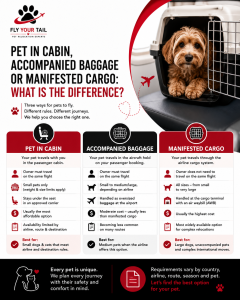
Quick comparison
In cabin
Pet travels: With you in the passenger cabin
Owner must travel: Yes
Pet size: Usually small
Kennel: Cabin carrier
Cost: Usually lowest
Availability: Limited by airline, route and destination
Accompanied baggage
Pet travels: In the aircraft hold on your passenger booking
Owner must travel: Yes, normally on the same flight
Pet size: Small to medium/large depending on airline
Kennel: Rigid travel kennel
Cost: Often moderate
Availability: Becoming less common on some routes
Manifested cargo
Pet travels: Through the airline cargo system
Owner must travel: Not necessarily
Pet size: Small to very large
Kennel: Airline-accepted live-animal kennel
Cost: Usually highest
Availability: Often the only option for large or unaccompanied pets and certain destinations
How Fly Your Tail can help
When I assess a relocation, I look at all available travel methods rather than automatically assuming cargo.
That can include:
- Cabin options
- Accompanied-baggage options
- Manifested cargo
- Alternative airports
- Alternative airlines
- EU land-bridge routes
- Road transport
- Flight nanny options
- Complex multi-country journeys
The aim is to find the most sensible viable option for your pet.
Because the best way to travel is not necessarily the one that sounds best when you first hear it.
It is the one that actually works for the pet, the route and the regulations.
Not sure how your pet can travel?
Send me your pet’s breed, weight, measurements, origin, destination and preferred travel date and I can assess the available options.